


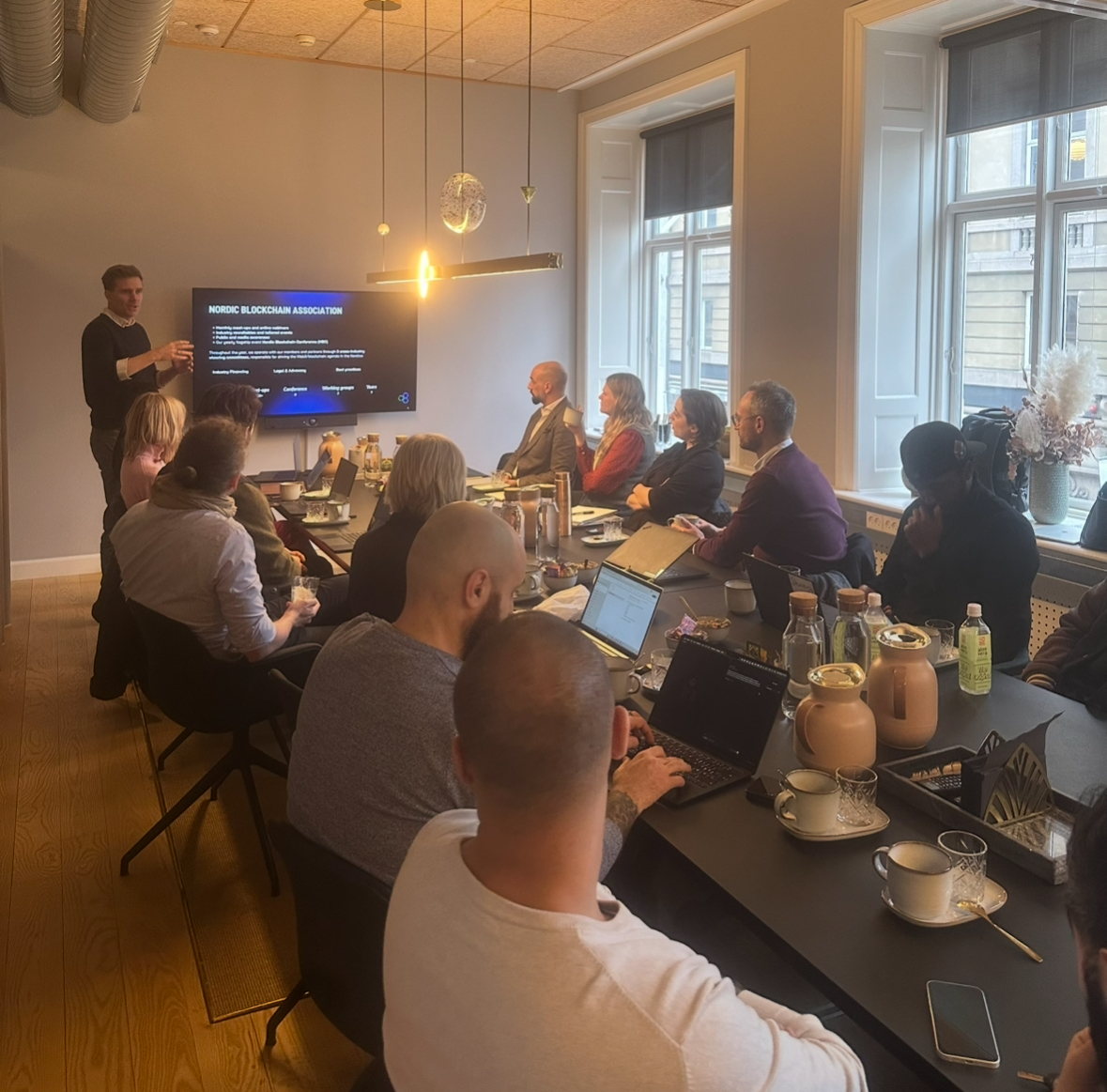
On January 29, Nordic Blockchain Association hosted an immersive, invitation-only workshop for a select group of NGOs in Copenhagen together with our partners UNDP AltFinLab, Stellar Development Foundation, ADVORA Law Firm, and Aryze.
The goal of the workshop was to move beyond abstract discussions of blockchain as frontier technology and instead support the attending NGOs in exploring where and how blockchain may add tangible, practical value to their everyday processes and operations.
By combining concise expert input, real-world NGO use cases, a live wallet demonstration and informal networking, attendees had the opportunity to discover how blockchain can strengthen their efforts in areas such as cross-border payments, supply/product tracking and fundraising.
Emphasizing practical value for NGOs
As with any horizontal technology, blockchain can be applied in many ways. For NGOs, its greatest value lies in supporting everyday operations by saving time and resources, increasing transparency, and improving trackability. Key examples include:
- Tracking donations from start to finish, enabling NGOs to show donors exactly where funds go at each step.
- Sending fast, low-cost payments to partners, employees, and projects - including cross-border transfers that can be completed in minutes with minimal fees.
- Following supplies along their journey, from warehouse to field or from medical supplier to hospital, with clearly defined handover points.
- Proving impact in real time by logging project milestones, so progress and outcomes are immediately visible to stakeholders.
Viewed through this lens, blockchain is not a total replacement for existing systems or technologies, but rather a practical tool to strengthen transparency, speed, and coordination in specific parts of NGO operations.
Live wallet demonstration, legal frameworks, and NGO case studies
The workshop brought together various expert perspectives to ensure discussions remained grounded and realistic.
- Jakob Mikkel Hansen, from Nordic Blockchain Association, opened the workshop and set the scene from a blockchain adoption perspective and the opportunities open for NGOs in terms of increased transparency, transaction speed and decreased costs.He then passed the baton to Magnus Jones, also from Nordic Blockchain Association, who gave an introduction to what blockchain is and the most important aspects of this technology.
- Aryze, represented by it’s co-founders Jack Nikogosian and Jodi Husain, gave an introduction to stablecoins, demonstrated live a stablecoin transfer, and spoke to its relevance for NGOs looking to, for instance, minimize currency exposure or limit banking transfer costs and time.
- UNDP AltFinLab, represented by Burcu Mavis, shared use cases from the recent UNDP Blockchain Accelerator cohort and the lessons learned from development and humanitarian contexts - helping participants understand where blockchain has already been used in practice and which challenges the technology has helped solve.
- Stellar Development Foundation, with a live wallet demonstration by Marton Kocsev, provided tangible insights into how blockchain-based payments and wallets actually work in conflict zones such as Ukraine and Syria.
- ADVORA Law Firm, represented by Nele Rickelt, addressed the most relevant legal and compliance frameworks, such as AML, KYC, MiCA, DAC6 and CARF - highlighting the importance of governance, regulation, and risk assessment when NGOs look to implement blockchain in their operations.
- Finally, Burcu Mavis from UNDP addressed fundraising and partnership considerations and the opportunities when collaborating with, for instance, blockchain protocol foundations.
Assessing fit, not forcing technology
A recurring theme throughout the workshop was that blockchain is not automatically the right solution for every NGO or every process. The value lies in understanding where it fits - and how to best apply it. By the end of the day, participants had not only gained practical insights into what blockchain is and how it can be used, but also a clearer sense of what adoption would require in terms of internal processes, legal considerations, and organisational readiness.
What comes next?
This workshop was designed to support NGOs in exploring the benefits and applications of blockchain in a structured and realistic way. For us at Nordic Blockchain Association, it reinforced the importance of creating spaces where people can come together to learn about the value of blockchain technology and make informed decisions based on their actual needs.
We are excited to continue the dialogue with the attending NGOs and support them as they begin to implement blockchain in their projects and operations.
A heartfelt thank you to everyone who participated, and of course to our partners - UNDP AltFinLab, Stellar Development Foundation, ADVORA Law Firm, and Aryze - whose expertise and collaboration made this workshop possible.
We look forward to continuing to explore how blockchain can strengthen transparency, efficiency, and impact across the NGO sector.